WhatsApp-first job management for South African trades.
binabio is WhatsApp-first job management software for South African trades: WhatsApp, web and phone enquiries land in one inbox, every one of them becomes a job card, and the quotation goes out and comes back approved on the customer's phone. The record belongs to the business, not to a chat thread.
In South Africa, most trades work already runs through WhatsApp: the enquiry, the site address, the photos of the burst geyser and the customer's go-ahead all sit in a chat thread on somebody's personal phone. The trouble starts later, when that thread is the only record of what was agreed.
Why does running a trades business on WhatsApp stop working?
It stops working the moment the business needs to remember something. A chat thread is a brilliant way to agree a callout and a poor way to keep a record: it cannot be searched by job number, and it lives on a phone the business does not own.
Nothing is searchable
Six months on, you need the quotation you sent for the Parkhurst geyser. It is buried in a thread that has run since summer, between a voice note and a photo of a bakkie.
The record lives on a personal phone
The site address, the gate code and the price agreed sit in one artisan's own chat history. When that person resigns, the history walks out with the handset.
An approval does not look like an approval
A customer types “ja, go ahead” at nine at night. No quotation number, no line items, no VAT, and nothing to attach to the invoice when the amount gets queried in March.
POPIA does not care that it was convenient
Customer numbers, ID photos and site addresses spread across personal handsets. The Protection of Personal Information Act (POPIA) expects you to know where that information sits and who can see it.
What is a WhatsApp business inbox for trades?
A WhatsApp business inbox for trades is a shared work inbox sitting behind one business number instead of an artisan's personal phone. Messages, photographs and addresses become a customer record and a job card that anyone in the office can search, and the history stays with the business when staff change.
What software has to do about it
One number the business owns
The line customers already know has to belong to the business, not to whoever answered it first, so answering is a shift and not a favour.
A record, not a thread
A message, a photo and an address have to become a job card, findable by job number, customer or street.
It has to survive a resignation
Quotations, photographs and certificates stay with the business when a person leaves. That is the whole test, and a chat thread fails it.
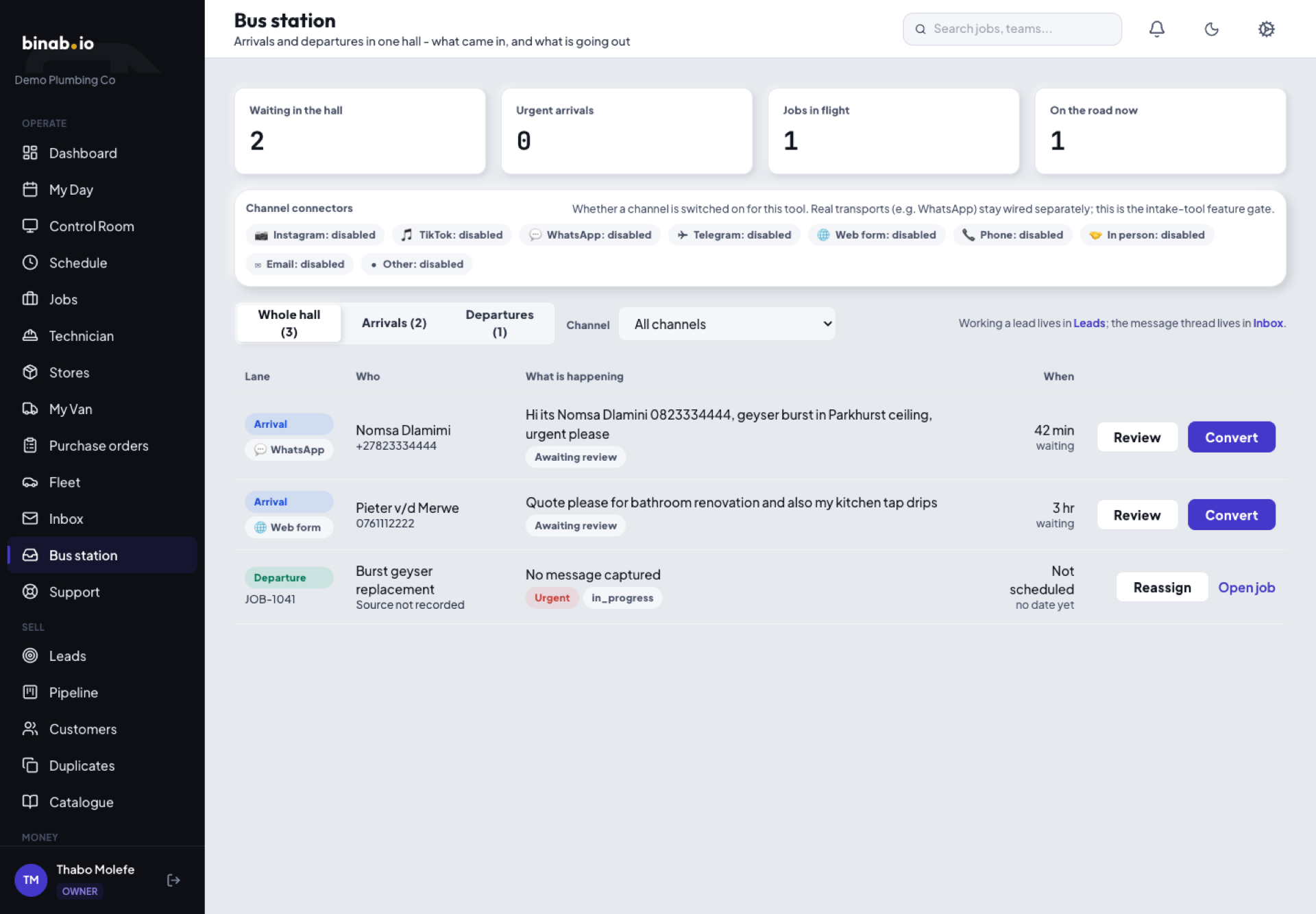
What does binabio do with WhatsApp?
Every enquiry lands in one inbox
WhatsApp, web and phone enquiries arrive on one intake desk instead of five places, with the photographs and the site address attached. Whoever is on shift works the queue, so a customer is answered by the business rather than by a personal handset.
Your own number, connected
You connect the WhatsApp Business number your customers already dial rather than publishing a new one. Connecting is a step-by-step ladder in settings, and the credentials go into an encrypted vault, never the database.
Every message becomes a job card
A message becomes a customer record and a job card without anyone retyping it: the address, the fault, the photographs and the promise made, findable afterwards by job number, customer or street.
The history stays with the business
Quotations, photographs and certificates stay on the customer record when an artisan leaves, so a resignation costs you a person and not the record of what was agreed.
How does a job run from a WhatsApp message to a paid invoice?
The same way it runs for an enquiry taken on the phone, which is the point: one sixteen stage rail from call to accounting export, where a quick callout takes the short path and an estimate-first job takes the long one.
The message lands in the inbox
A customer sends a WhatsApp message with a photo of the burst geyser and an address. It arrives on the intake desk beside the web enquiries and the phone callouts, timestamped, in the queue rather than in a thread.
The enquiry becomes a job card
One tap turns it into a customer record and a job card, with the address and the photographs kept against the job, findable afterwards by job number, customer or street.
The quotation goes out from your pricebook
The quotation builds from your own pricebook with cost and sell loaded, passes an admin confirm gate before it leaves, and the customer approves it on their own phone.
The artisan works the job card
The technician app works offline, in a basement or out of signal, and syncs when the bakkie is back in coverage. Photos and certificates file against the job card as an evidence pack.
The invoice runs off the same record
The invoice runs off the same record, with nothing retyped between callout, quotation, job and invoice. Card and instant EFT payments are built in with pay by link, so the invoice carries its own payment page in your branding.
The history stays with the business
The job card, the quotation and the photographs stay on the customer record when an artisan leaves. Your books come out in one click, free and in full: invoices, payments, jobs and customers.
How much does it cost, in rand?
The WhatsApp business inbox lives in the Command package, R5,500 a month for the whole platform with 40 seats included. Field, at R1,500 a month, takes jobs in by email and website form. The trial runs 14 days from your first logged job, or 30 days with a promo code.
Questions people actually ask.
What happens to a WhatsApp enquiry that arrives after hours?
It lands on the intake desk with a timestamp and waits in the queue, not in somebody's personal chat. In the morning the whole night sits in one place: turn each enquiry into a job card, book it into the diary and reply from the record rather than scrolling back through a thread.
Can I keep the WhatsApp number my customers already have?
Yes, that is the design: you connect the business number your customers already dial rather than publishing a new one. One condition is not ours to waive, which is that a number connected to a business platform cannot also be in use on the ordinary WhatsApp app on a handset.
What happens to my WhatsApp history when an artisan leaves?
A chat history on a personal phone leaves with the phone, and that is the risk this page is about. binabio keeps the job card, the quotation, the photographs and the customer record with the business rather than the handset, so a resignation costs you a person and not the record.
How much does WhatsApp-first job management cost in South Africa?
The WhatsApp business inbox is part of the Command package at R5,500 a month, which carries the whole platform with 40 seats included. Field, at R1,500 a month with 20 seats included, runs job cards, quoting, invoicing and payments with intake by email and website form. Pricing is published in rand, excludes VAT, and you can cancel at any time.
Do I need WhatsApp at all to use binabio?
No. binabio runs as job management software with or without it: whoever takes the call captures the enquiry on the intake desk, web enquiries land on the same desk, and job cards, quotations and invoices run the same way. Connecting your number adds the channel your customers already use.
Start with the thread you cannot search.
Take the 90-second check and see what the scattered threads cost you in rework and forgotten callouts.
Last updated: 27 July 2026.