Field service management software for South African trades.
Field service management software, or FSM, is the one system a business runs its away-from-the-office work on: the enquiry, the quotation, the job card, the artisan on site, the invoice and the payment, on a single record. binabio is FSM software built for South African trades and priced in rand.
What is field service management software?
It is one system for work that happens away from the office. An enquiry becomes a customer record, a job card and a scheduled visit; the artisan works from that same record on a phone; the quotation, the invoice and the payment run off it too, so nothing is retyped between the call and the money.
Is a job card the same as a work order?
Yes. A job card is the South African term for a work order: the record of a specific job, who it is for, who is doing it, when, and what gets quoted and invoiced. binabio creates and tracks job cards digitally, so the book in the bakkie stops being the only copy.
What does an FSM system cover?
Intake
Every enquiry lands in one inbox: a WhatsApp message, a web enquiry and a callout taken on the phone, captured once and never retyped. Each one becomes a customer record and a job card, with the address and the photographs kept against the job.
Dispatch and job cards
Job cards and a dispatch board put every job, crew and promise on one screen instead of three group chats, so the office sees the whole day at once.
The work on site
The technician app works offline, in a basement or out of signal, and syncs when the phone reconnects. Photos, serial numbers and certificates file against the job card as the work happens.
Quotation and approval
Quotes build from your own pricebook, cost and sell already loaded, with an admin confirm gate before anything goes out. The customer approves on their own phone.
Invoice and payment
The invoice runs off the finished job card, VAT and all. Card and instant EFT payments are built in with pay by link, so the invoice carries its own payment page and the money lands against the job it came from.
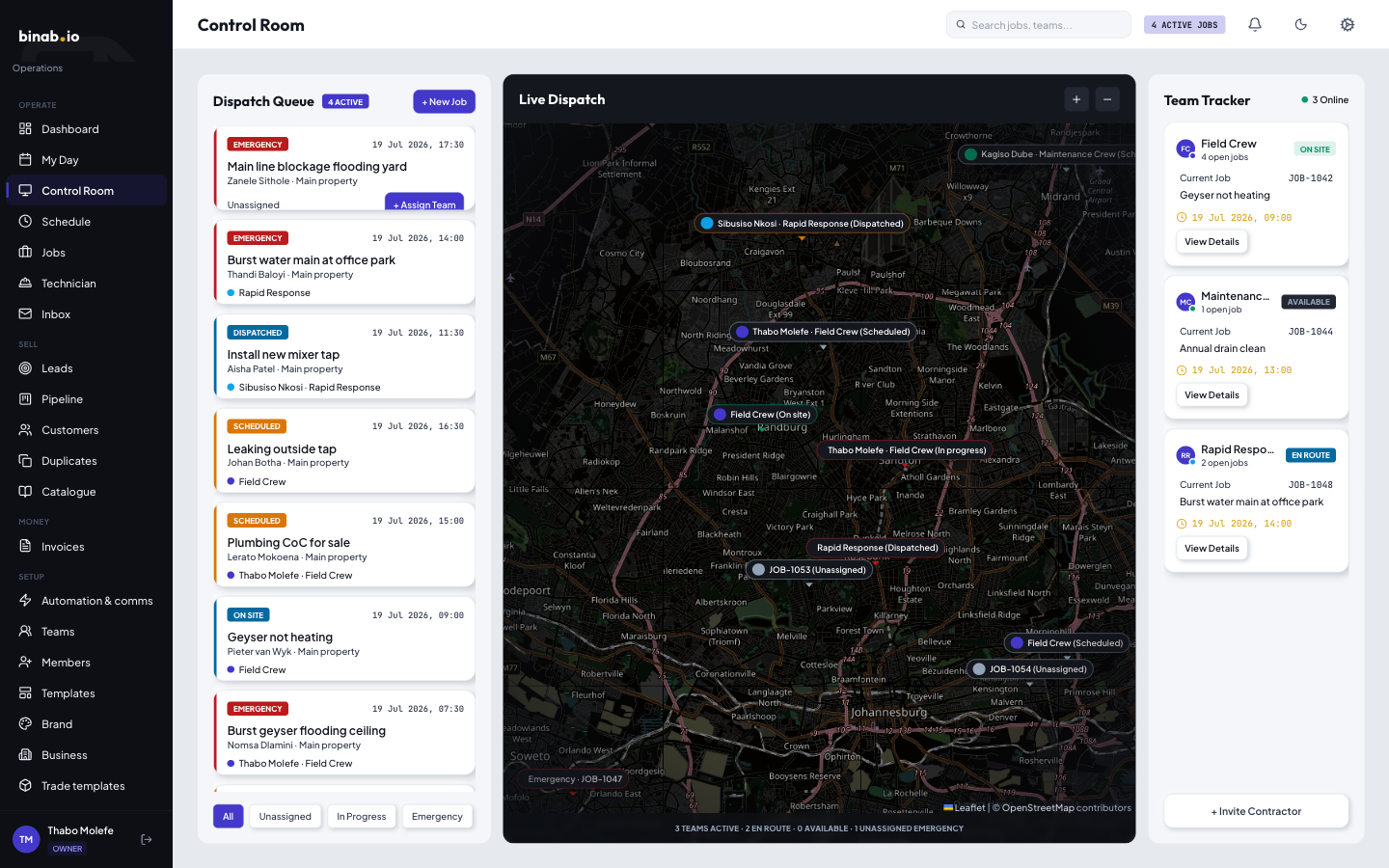
What does the software actually look like?
The whole day on one board
One dispatch board holds every job, crew and bakkie, instead of a whiteboard and three group chats. Customer records and history live in one place, so March's callout is there when the same geyser argues in September.
One record, call to cash
The invoice runs off the finished job on the same record, with nothing retyped between call, quotation, job and payment. One sixteen stage rail carries it: a quick job takes the short path, a quoted job the long one.
Your brand, not ours
White-label branding puts your logo and colours on quotations, invoices, payment pages and the customer portal, so the customer sees your business, not the software behind it.
What should a South African trades business look for in an FSM system?
Six questions: rand pricing and VAT, power and signal, WhatsApp, instant EFT as well as card, compliance paperwork, and what you can get back out.
Is it priced in rand?
A licence priced in dollars moves with the exchange rate, and your margin with it. Ask for a published rand price, and check that quotations and invoices carry VAT and your VAT number properly. binabio publishes its pricing in rand, with nothing hidden.
Does it work when the power and the signal are gone?
Load-shedding takes the fibre with it, and a basement has never had a bar of signal. A system that needs a live connection to close a job will cost you the job card. The binabio technician app works offline and syncs when the phone reconnects.
Does it meet the customer on WhatsApp?
Here a customer sends a voice note, not a support ticket, so WhatsApp should be first-class and not a bolt-on. binabio pulls WhatsApp, web and phone enquiries into one inbox, and you connect the WhatsApp Business number your customers already dial rather than publishing a new one.
Does it take instant EFT as well as card?
Plenty of customers will pay by instant EFT before they will type in a card number. Card and instant EFT are both built in, with pay by link, so an invoice carries its own payment page in your branding and the payment lands against the job it came from.
Does it carry the compliance paperwork?
A sparky issues a CoC, a certificate of compliance, and somebody will ask for a geyser's serial number six months later. binabio runs structured checklists on site across six trade verticals, and evidence packs file photos, serial numbers and certificates against the job card.
What can you get back out?
POPIA, the Protection of Personal Information Act, puts the duty of care for your customers' details on you, so ask any supplier what leaves the system and in what format. binabio gives you one-click data export, free and in full: invoices, payments, jobs and customers, as files your bookkeeper can open.
How much does field service software cost in South Africa?
binabio publishes its pricing in rand, excluding VAT. Field is R1,500 a month with 20 seats included, then R150 a seat a month; Command is R5,500 with 40 seats included, then R150 a seat a month. Packages differ by what they switch on and by payment rates.
Card sell rates run from 2.95% + R1,50 on Field to 2.75% + R1,25 on Command, and instant EFT from 2% to 1.75%. The trial runs 14 days from your first logged job.
Questions people actually ask.
What is field service management software, in plain English?
It is one system for work done away from the office. The enquiry, the quotation, the job card, the artisan on site, the invoice and the payment all run off a single record, so the office and the bakkie see the same job and nothing gets retyped.
What is different about running field service software in South Africa?
Four things. Pricing and VAT are in rand, load-shedding and patchy signal mean the phone app has to work offline, customers talk on WhatsApp rather than email, and instant EFT matters as much as card. Compliance paperwork such as a certificate of compliance comes off the job too.
How much does it cost?
Two packages. Field is R1,500 a month with 20 seats included and runs the working day: job cards, calendar scheduling, quoting, invoicing and payments. Command is R5,500 and adds the dispatch board, the live team map, the warehouse and the WhatsApp inbox, with 40 seats included, then R150 a seat a month. Accounting sync is an add-on on Field and included in Command. Pricing is published in rand, excludes VAT, and you can cancel at any time.
Does it work offline when the power or the signal goes?
Yes. The technician app works offline, in a basement or out of signal, and syncs when the phone reconnects, so a job card can be closed with photos and a signature during load-shedding. The office sees the finished job as soon as the phone finds a tower again.
Can I connect the WhatsApp number my business already uses?
Yes. You connect the WhatsApp Business number your customers already dial rather than publishing a new one, so nobody has to learn a new line. One condition is not ours to waive: a number connected to a business platform cannot also be in use on the ordinary WhatsApp app on a handset.
See it against your own week.
Ninety seconds of questions about how jobs, quotations and money move through your business today, then a straight answer.
Last updated: 27 July 2026.