Job card software for South African trades.
Job card software is the system a South African trades business uses to raise, track and close a job card: the customer, the site, the artisan, the quotation, the parts and the invoice on one record. binabio is field service software for South African plumbers, electricians and builders, priced in rand.
What is a job card?
A job card is the South African term for a work order: the record of a specific job, who it is for, who is doing it, when, and what gets quoted and invoiced. binabio creates and tracks job cards digitally, on one record the office and the artisan both work from.
What does the software actually do?
It replaces the paper book and the group chat with one record per job. The job card holds the customer, the address, the fault, the artisan assigned, the parts used, the quotation, the photos and the invoice. Everyone works off the same record, so nothing gets retyped between the call, the quote and the invoice.
How is a digital job card different from a paper one?
A paper job card sits in the bakkie until Friday. A digital job card updates while the work happens: photos, serial numbers and certificates attach on site and file against the card, the quotation prices off your own pricebook, and the invoice with VAT runs off the same record.
Where does the job card come from?
Every enquiry lands in one inbox instead of five places: a WhatsApp message, a web enquiry and a phone callout typed in as the call is taken. One tap turns any of them into a customer record and a job card, so the work starts on the record rather than in somebody's chat thread.
What does a job card have to carry in South Africa?
The callout as its own line, labour and materials kept apart, VAT and your VAT number on the paperwork, and the compliance evidence the trade produces: serial numbers, site photographs and a CoC where one is issued. binabio files all of it against the job card, so the record answers the question six months later.
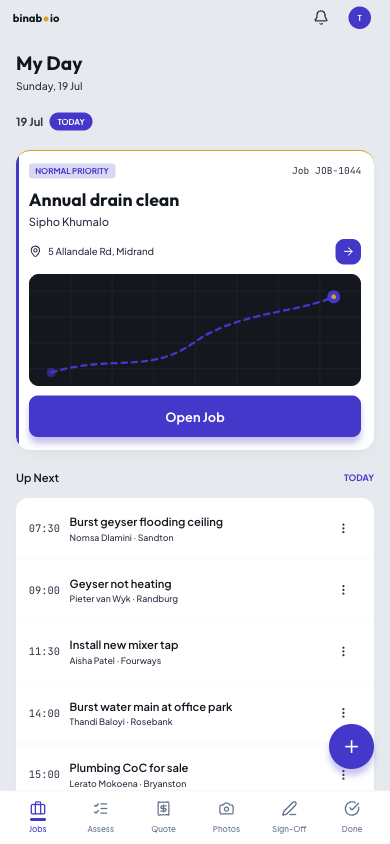
What does a job card look like in the app?
It looks like the day in the order the day happens: the job, the checklist, the pricebook and the camera, on the phone of the person doing the work. The office sees the same card on the dispatch board at the same time.
One record, call to cash
Job cards and a dispatch board put every job, crew and promise on one screen instead of three group chats, and the invoice runs off the same record with nothing retyped between the call, the quote, the job and the money. Customer records and history sit behind the card, so the next callout starts with what happened last time.
It works where the signal does not
The technician app works offline, in a basement or out of signal, and syncs when the phone reconnects. Photos, serial numbers and certificates captured on site bundle into an evidence pack, filed against the job card rather than sitting in someone's camera roll.
Quotation approved, invoice paid
Quotes are approved by the customer on their own phone, and card and instant EFT payments are built in with pay by link. The invoice carries its own payment page in your branding, so the customer can settle it in the driveway before the bakkie pulls off.
How does a digital job card work, step by step?
One job card moves through six moments, from the callout to the money. Behind them, the platform runs one sixteen stage rail from call to accounting export: a quick service job takes the short path and an estimate-first job takes the long one.
The callout gets captured
A WhatsApp message, a web enquiry and a phone callout all land on the same intake desk: name, address, fault, photographs. Nothing waits in a personal chat thread, and nothing gets retyped once it is on the desk.
The job card opens
One tap turns the enquiry into a customer record and a job card: the address, the fault, the promise made and who the work belongs to, on one record instead of three group chats.
The artisan gets the work
The card goes onto the dispatch board and onto the artisan's phone with the day's route. The app works offline, in a basement or out of signal, and syncs when the phone reconnects.
The quotation goes out
The quote builds from your own pricebook, with cost and sell already loaded, and an admin confirm gate before anything leaves. The customer approves it on their own phone, in the driveway if that is where they are.
The evidence stays with the card
Photos, serial numbers and certificates captured on site file against the job card as an evidence pack, so a query about a CoC (certificate of compliance) two years later has an answer on the record.
The invoice goes out and gets paid
The invoice runs off the same job card, VAT and all, with nothing retyped. Card and instant EFT payments are built in with pay by link, so the invoice carries its own payment page and the customer settles it on their phone.
The whole rail, stage by stage, sits on the platform page. If the mess you are trying to fix is quoting and invoicing rather than the job itself, start with quoting and invoicing.
How much does job card software cost in South Africa?
Packages start at R1,500 a month with 20 seats included, and job cards are in both packages. Packages differ by what they switch on and by payment rates: card runs 2.95% + R1,50 on Field and 2.75% + R1,25 on Command, instant EFT 2% and 1.75%. Pricing is published in rand with nothing hidden, and you can cancel at any time.
The trial runs 14 days from your first logged job, or 30 days with a promo code. Onboarding is done with you on every package: we load your customers, pricebook and quote template with you in one working session, so you start with a working system rather than an empty app.
Questions people actually ask.
What is a digital job card system?
Job card software is the system a South African trades business uses to raise, track and close a job card, from the first callout to the invoice. binabio keeps the customer, the site, the artisan, the quotation, the photos and the invoice on one record, so nothing gets retyped.
How much does a job card app cost in South Africa?
binabio publishes its prices in rand, excluding VAT: packages start at R1,500 a month with 20 seats included. Packages differ by what they switch on and by payment rates. The trial runs 14 days from your first logged job, or 30 days with a promo code. You can cancel at any time.
Does the job card work without signal on site?
Yes. The technician app works offline, in a basement or out of signal, and syncs when the phone reconnects. The artisan opens the job card, runs the checklist, captures photos and serial numbers and closes the job, and the office record catches up the moment the phone finds a network again.
What happens to a callout that comes in after hours?
It lands on the intake desk with a timestamp and waits in the queue, not in somebody's personal chat. In the morning the whole night sits in one place: turn each enquiry into a job card, book it into the diary and reply from the record rather than scrolling back through a thread.
Which trades is binabio built for?
binabio is field service software for South African trades businesses such as plumbers, electricians and builders. An assessments and compliance engine runs structured checklists on site across six trade verticals, and scheduling, diary, customer history and white-label branding are included on every package.
Can I get my books out again?
Yes. One-click data export hands your books back, free and in full: invoices, payments, jobs, customers and the job history, as files you can pass straight to your accountant. There is no charge to take them and no waiting period, pricing is published in rand with nothing hidden, and you can cancel at any time.
See it against your own week.
Ninety seconds of questions about how jobs, quotations and money move through your business right now, whether the bakkie is in Gauteng or the Western Cape. Then a straight answer about what a job card system would actually change.
Last updated: 27 July 2026.